
IM BLOG: Sustainability in Information Management: Why It Matters Now More Than Ever

Our aim is to reduce environmental impacts through such measures as energy efficiency, waste reduction, and sustainable sourcing. To this end an Environment Committee has been established.
One of the Committee’s first tasks is to take action during Information Awareness Week March 2026 by encouraging records and information management practitioners to participate in World Digital Cleanup Day.
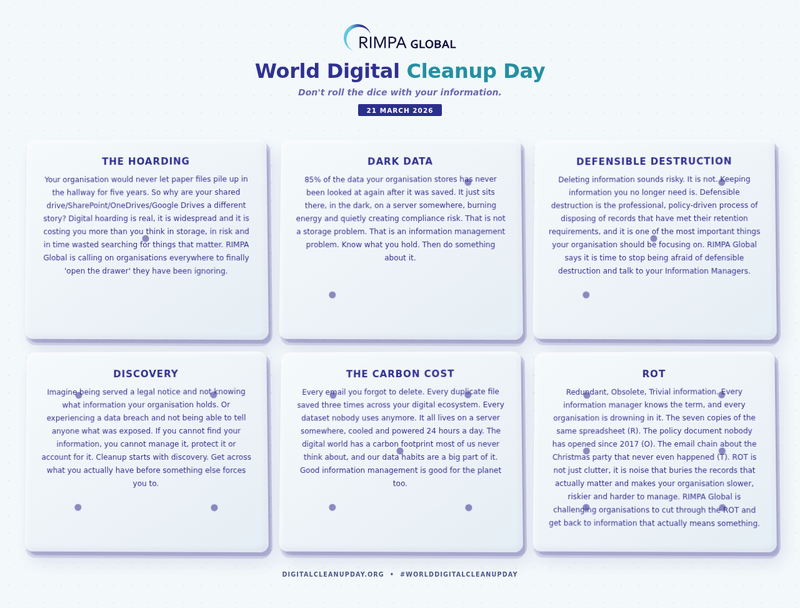
Digital Cleanup Day on 21 March 2026
Clean Up Your Digital Footprint
Strengthen Your Organisation and the Planet
Every organisation creates vast amounts of digital data every day: emails, documents, images, system backups, unused applications, and legacy files. Over time, this invisible buildup becomes digital clutter, quietly increasing costs, raising security risks, slowing teams down, and consuming energy around the clock.
A digital cleanup transforms this challenge into an opportunity: leaner systems, lower risk, and measurable environmental impact.
Why Digital Cleanup Matters
Digital technologies are responsible for an estimated 2 – 4% of global greenhouse gas emissions, a footprint comparable to the aviation industry. Much of this impact comes from data centres that must continuously power and cool stored information, even when that data is no longer used.
The problem isn’t just how much data we create, it’s how much we keep unnecessarily.
Small Actions. Real Impact.
Collective digital cleanup initiatives are already delivering results. In 2025 alone, participants removed more than 2.3 million gigabytes of redundant data, preventing an estimated 575 tonnes of CO₂ emissions every year, and reducing other environmental impacts.
When organisations and individuals act, even simple steps can create meaningful change.
Benefits for Your Organisation
A digital cleanup is one of the simplest, highest‑impact actions your organisation can take:
- Reduce operational costs by cutting storage and infrastructure demand
- Lower cyber and compliance risk by removing outdated and unmanaged data
- Improve productivity with faster, cleaner systems
- Support sustainability goals with measurable environmental benefits
Whether you start with email inboxes, cloud storage, shared drives, or legacy systems, every deleted file and retired application contributes to a cleaner, safer, more efficient digital environment.
Lead the Change
Digital sustainability is now part of modern environmental responsibility. By taking action today, your organisation can reduce its digital footprint while strengthening performance, resilience, and reputation.
Clean up your data. Strengthen your systems. Support the planet.
Download Our Digital Cleanup Checklist for Suggested Actions to be Taken
References and Further Resources
Digital Cleanup Day 2025 Results
News Blog – Digital Cleanup Day 2026
CyberCoach – Digital Cleanup Blog
Vandemoortele – Global Digital Cleanup Day
Meet your blog authors:
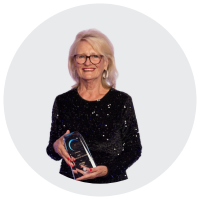
Joy Siller ARIM (Life) - Portfolio Lead: Social Responsibility - Environment
Joy Siller is the Managing Director of Siller Systems Administration, a private information management consulting business. She has over 40 years’ experience in information management field having started in the NSW State Archives Office in the 1980s. She has undergraduate and post-graduate qualifications in library science (BA Lib Sc) and business/marketing (Master of Business).

Sarah Eddy CERIM ARIM - Ambassador
Sarah is an IT-forward Information Governance Specialist who simplifies complexities so that people can go about their business unhindered.
With close to two decades spanning governance, IT and information governance, she's partnered with dozens of organisations in both the public and private sectors to align information requirements with operational objectives.
Sarah's approach is practical, governance should enable, not burden and information should be managed in a way that supports better decisions, accountability, security and trust. I’m motivated by making frameworks work in real-world environments, whether in complex organisations or during times of change.