
IM BLOG: The Trust Equation: Why Knowledge Without Approachability Kills Your Influence

Picture this scenario: Sarah, a senior information manager with 15 years of experience, sits in her office surrounded by ISO standards, compliance manuals and technical documentation. Her phone rarely rings. When colleagues need help with records management, they ask junior staff members first, hoping to avoid the inevitable lecture filled with acronyms and regulatory references.
Meanwhile, down the hall, Mike from IT fields constant questions about data management. His technical knowledge is decent but not exceptional. Yet people flock to him because he listens, speaks plainly and never makes anyone feel stupid for asking.
Who has more influence in the organisation? The answer might surprise you.
The Knowledge-Approachability Matrix: Where Do You Really Stand?
Most information management professionals have mastered the technical side of their role. We can navigate complex retention schedules, implement metadata frameworks and recite compliance requirements from memory. But here's the uncomfortable truth: expertise without approachability is like having a Ferrari without keys – impressive to look at but it won't get you anywhere.
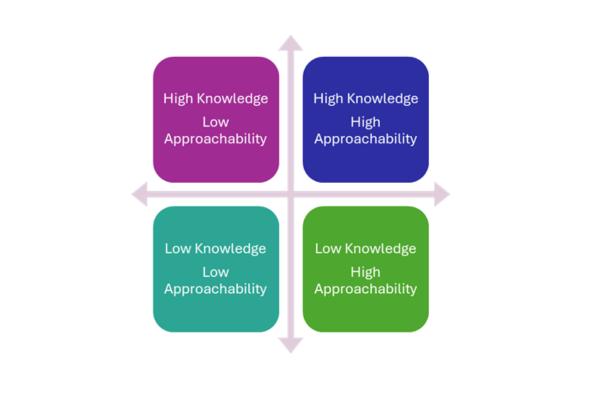
The knowledge-approachability matrix reveals four distinct professional personas:
High Knowledge, Low Approachability (The Unapproachable Expert): You're technically brilliant but intimidating. People respect your expertise but avoid seeking your help unless absolutely necessary. You're the last resort, not the first choice.
Low Knowledge, Low Approachability (The Ineffective Professional): This is career danger territory. Without expertise or interpersonal skills, you're neither trusted nor liked. This quadrant requires immediate attention on both fronts.
Low Knowledge, High Approachability (The Friendly Amateur): People enjoy working with you, but they won't rely on you for critical decisions. You're seen as helpful but not authoritative.
High Knowledge, High Approachability (The Trusted Advisor): This is the sweet spot. You combine deep expertise with the ability to communicate effectively and build relationships. You're the person others seek out for guidance.
The Jargon Trap: When Expertise Becomes a Barrier
Last month, I witnessed a perfect example of this dynamic during a board presentation. Lisa, an experienced records manager, opened with: We need to implement BCS compliance for our RDA requirements to ensure proper descriptive metadata capture across our EDRMS deployment.
The room fell silent. I watched five executives' faces glaze over in real time. The CEO started checking his phone. The CFO doodled on his notepad. In thirty seconds, Lisa had lost her audience entirely.
What she meant to say was: We need to organise our documents better so we can find important information quickly and keep records for the right amount of time to avoid legal problems.
Same message, completely different impact. The technical version demonstrated Lisa's expertise but created a barrier between her and her audience. The plain English version invited engagement and understanding.
This is the jargon trap – the mistaken belief that complex language equals credibility. It often signals insecurity or a lack of empathy for the audience.
Why Approachability Multiplies Your Impact
Consider two scenarios:
Scenario A - James, a compliance officer, responds to questions with detailed policy citations and regulatory references. His answers are technically perfect but take ten minutes to deliver and require follow-up clarification. Colleagues eventually stop asking.
Scenario B - Maria, also a compliance officer, listens carefully to questions, asks clarifying questions and provides concise, practical answers in plain language. She follows up with simple one-page summaries. Her phone rings constantly because people trust her to provide useful guidance quickly.
Both professionals have similar knowledge levels, but Maria's approachability makes her exponentially more influential. She's not just enforcing compliance, she's enabling her organisation to work more effectively.
Building Bridges, Not Walls
Approachability isn't about dumbing down your expertise – it's about building bridges to understanding. Here are practical strategies to move toward the high-knowledge, high-approachability quadrant:
Translate, Don't Educate - Instead of explaining what EDRMS stands for, explain what it does: a system that helps us store, find, and manage our important documents automatically.
Use the "So What?" Test - After explaining any technical concept, ask yourself: So what? Why should they care? Lead with the impact, not the mechanism.
Listen First, Solve Second - Before jumping into solutions, understand the real problem. Often, what people think they need isn't what they actually need.
Visual Communication - Complex processes become clearer with simple diagrams, flowcharts or timelines. A picture really is worth a thousand acronyms.
Follow the 70-20-10 Rule - Spend 70% of your communication time on benefits and outcomes, 20% on the process and 10% on technical details.
Real-World Transformation
Take David, a records manager at a manufacturing company. For years, he was known as the policy police – technically correct but approachable as a parking ticket. Employees would hide paper documents rather than ask him about proper filing procedures.
David's transformation began when he started visiting departments instead of waiting in his office. He asked questions: What documents do you work with daily? Where do you store them? What happens when you can't find something?
Instead of lecturing about retention policies, he created simple visual guides showing Keep, Review and Destroy categories with examples specific to each department. He hosted Coffee and Questions sessions where people could ask anything without judgment.
Within six months, compliance improved dramatically – not through enforcement, but through engagement. David became a trusted partner rather than a necessary evil.
The Trust Equation in Action
Trust in information management follows a simple equation: Competence + Reliability + Intimacy - Self-Orientation = Trust
- Competence - Your technical knowledge and expertise
- Reliability - Consistent follow-through on commitments
- Intimacy - People's comfort level in sharing sensitive information with you
- Self-Orientation - The degree to which you focus on yourself versus your client
High knowledge addresses competence. High approachability builds reliability and intimacy while reducing self-orientation. You're not showing off your expertise, you're solving problems.
Moving Forward: Your Action Plan
Assess your current position honestly. Are you the expert people avoid or the advisor they seek? Here's how to move toward the high-knowledge, high-approachability quadrant:
Week 1-2: Audit your communication. Record yourself explaining a complex process. Count the jargon words. Rewrite in plain English.
Week 3-4: Practice active listening. Ask three clarifying questions before offering any solution.
Week 5-6: Create visual aids for your most common explanations. Test them with non-technical colleagues.
Week 7-8: Implement regular check-ins with key stakeholders. Focus on their challenges, not your solutions.
The Bottom Line
In information management, influence isn't built on knowledge alone – it's built on trust. And trust requires the courage to be both expert and human, knowledgeable and approachable.
The next time you're tempted to impress someone with technical terminology, remember: your goal isn't to demonstrate how much you know. It's to help others understand how your knowledge can solve their problems.
That's the difference between being an expert nobody asks and becoming the trusted advisor every organisation needs. The choice is yours – which quadrant will you choose to occupy?
Meet your blog author:
Anne Cornish CSRIM MRIM (Life)
Anne is a seasoned professional with over 30 years of experience in the information and records management arena, working with all levels of government and most large private industry sectors. She is the CEO of RIMPA Global, the peak body for records and information management professionals in Australasia and beyond.