
IM BLOG: Reviewing Existing R&IM Practices to Minimise Environmental Impacts
One of the ways that information managers can help reduce the environmental impact of digital information is to reduce the amount that we make and keep. Accordingly, we need to review some of our current practices. In doing so, we can consider how tools such as Artificial Intelligence (AI) can be used responsibly to assist us, rather than exacerbating the problem. We can look at all aspects of information management practices, but I’d like to focus on disposal.
A Potted History of Disposal in Australia
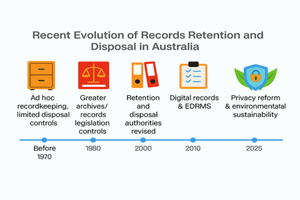
Before the 1970’s, disposal decisions were often ad hoc and inconsistent, with a somewhat vague legal basis. Rudimentary archives legislation that applied to government records existed in South Australia (1925) and New South Wales (1960).
From the late 1980s onward, Australian archival practice increasingly relied on formal appraisal and compliant disposal authorities. There was a more widespread requirement to sentence records against approved authorities that specified minimum retention periods and identified records to be preserved permanently as archives. This approach aimed to balance operational needs, accountability, and historical value while reducing random or excessive retention.
During the 1990s and early 2000s, retention and disposal practices became more closely tied to accountability, freedom of information, and legal risk. Decisions increasingly factored in litigation risk, audits, royal commissions, and inquiries, leading to mechanisms such as disposal freezes during legal or investigative processes. Proper disposal was recognised not as destruction for convenience, but as a controlled, auditable process essential to good governance.
During this time, the move from paper to digital appears to have changed how users thought about and treated information. Dealing with paper records was more likely to have encouraged careful and controlled recordkeeping, but digital formats made users less committed to a structured approach to information management.
This rapid shift from paper to digital records also significantly reshaped retention and disposal practices. By the mid 2000s, Australian governments acknowledged that digital records were subject to the same legal obligations as paper records under the Archives Act and equivalent state legislation.
Why is Disposal Important
Today, records disposal is recognised as a foundational element of effective information management in Australia, underpinning transparency, operational efficiency, legal and regulatory compliance, and the maintenance of public trust across government institutions. Increasingly, it is also significant within the context of environmental responsibilities, as well considered disposal decisions help reduce unnecessary data storage, energy consumption, and the broader environmental impacts associated with the long-term preservation of redundant information.
Data centres now consume around 1.5 percent of global electricity, with that figure expected to more than double by 2030. Much of what is stored in them has never had a disposal decision made about it. Research from Loughborough University suggests up to 60 percent of stored data is dark data which is kept and never used again. Consistent application of disposal authorities is one of the most direct things information managers can do to mitigate this impact.
Big Buckets = Big Storage
The big bucket approach was introduced to simplify records retention by grouping information into broad functional categories rather than maintaining detailed, activity-based schedules. In part, it was a response to the scale and complexity of digital information, where traditional retention models can be difficult to apply consistently. Overall, the big bucket approach is best understood as a risk-based compromise.
While the approach can reduce classification effort and corresponding administrative overhead, it sacrifices precision for convenience by applying shared retention periods to wide groupings of records. This can result in over-retention, where records with shorter or lower value retention requirements are retained longer because they are captured within larger, long-term buckets.
Over retention may increase storage costs, access risks, and governance challenges, particularly in large digital environments.
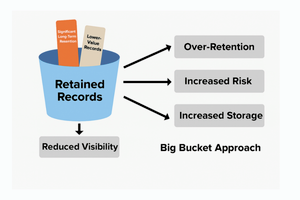
While we want to make sure that information of ongoing value to society and the collective memory of humanity is captured and preserved properly, its combination with information of lesser importance is likely to hinder this objective.
Using AI in Retention and Disposal Decisions
In response to the limitations of ‘big buckets’, some organisations are exploring artificial intelligence and automated analytics to support more granular retention decisions, given AI’s ability to process large volumes of information.
The extent to which AI can successfully balance the efficiency of big buckets with the accuracy of fine-grained disposal decisions remains uncertain and evolving.
Content and context-based analysis
AI could be used to examine the actual content and metadata of records (such as keywords, document structure, authorship, dates, and referenced entities) to distinguish between records that appear similar at a high level but have different retention value (see diagram below). For example, within a single “project records” bucket, AI might identify routine administrative material versus records documenting key decisions or approvals, allowing routine items to be disposed of earlier while retaining higher value records longer. This approach relies on automated pattern recognition rather than manual file by file review, but would still require human oversight to manage classification and disposal confidence and risk.
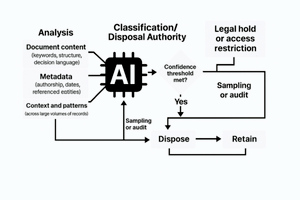
Are there risks with the use of AI? Of course, but records disposal has always carried an element of risk, including subjectivity, inconsistency and other human errors. If it can lead to less retention of masses of obsolete information, surely it’s worth consideration. In fact, bigger and better ways of doing this are probably occurring as this article is being published and read.
References and Further Reading
Australian Law Reform Commission, Australia's Federal Record : A Review of Archives Act 1983, Report No 85, 1998, https://www.austlii.edu.au/cgi-bin/viewdoc/au/other/lawreform/ALRC/1998/85.html
Australian Law Reform Commission, Secrecy Laws and Open Government in Australia (ALRC Report 112), 11 March, 2010 https://www.alrc.gov.au/publication/secrecy-laws-and-open-government-in-australia-alrc-report-112/16-interactions-with-other-laws/archives/
Canning, D.; Saillant, L. AI to review government records: new work to unlock historically significant digital records, AI & Society, 22 Feb, 2025, https://www.researchgate.net/publication/389250509_AI_to_review_government_records_new_work_to_unlock_historically_significant_digital_records
Gimmal Product Marketing, Data Retention Policies in the Aliera: What’s Changing? Jan 16, 2025 https://gimmal.com/data-retention-policies-in-the-ai-era-whats-changing/
International Energy Agency 2025, Energy and AI, IEA, Paris https://www.iea.org/reports/energy-and-ai
Jackson, T. and Hodgkinson, I. 2024, Why, Where and When Dark Data Affects Greenhouse Gas Emissions, Academy of Social Sciences Policy Brief https://acss.org.uk/publications/why-where-and-when-dark-data-affects-greenhouse-gas-emissions
Modiba, M. Adoption of artificial intelligence to enhance records management practices at Gauteng Department of Education in South Africa, Emerald Publishing, August 27, 2024 https://www.emerald.com/cc/article/44/1/9/1239457/Adoption-of-artificial-intelligence-to-enhance
National Archives of Australia, Retaining, managing and disposing of data and datasets, (undated) https://www.naa.gov.au/information-management/disposing-information/retaining-managing-and-disposing-data-and-datasets
Rajeev, R. Pros and Cons of Using AI vs Manual Analysis, Sep 26, 2025 https://www.deepknit.ai/blog/pros-cons-using-ai-vs-manual-analysis/#:~:text=The%20major%20differentiator%20between%20the,and%20manual%20analysis%20of%20data
Saffady, W. Big Bucket Retention: Objectives, Issues, Outcomes, Dec 7, 2018, ARMA Magazine https://magazine.arma.org/2018/12/big-bucket-retention-objectives-issues-outcomes/
Meet your blog authors:

Joy Siller ARIM (Life) - Portfolio Lead: Social Responsibility - Environment
Joy Siller is the Managing Director of Siller Systems Administration, a private information management consulting business. She has over 40 years’ experience in information management field having started in the NSW State Archives Office in the 1980s. She has undergraduate and post-graduate qualifications in library science (BA Lib Sc) and business/marketing (Master of Business).