
The Quantum Leap: Redefining Records Management for the Qubit Era
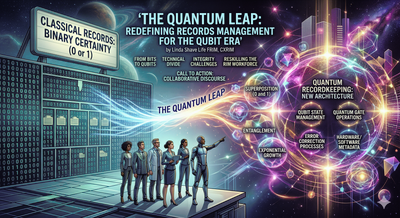
The transition from classical computing to quantum mechanics demands a total reconfiguration of the information governance landscape. This shift is not merely a technical upgrade; it is a strategic revolution Linda Shave warns. For the Records and Information Management profession, quantum computing forces a move away from simple data processing toward a fundamental reimagining of how information is captured, secured, managed and preserved.
From Bits to Qubits: Navigating the Technical Divide
The migration from binary bits to quantum qubits represents a structural transformation of information itself. While classical computing is confined to the binary certainty of 0 or 1, quantum computing leverages properties that defy traditional logic:
- Superposition: The ability of a qubit to exist in a simultaneous state of 0 and 1. This allows computational capacity to grow exponentially, rather than linearly, with every added qubit.
- Entanglement: A phenomenon where qubits become interconnected, allowing for unprecedented speeds in calculating and extracting results.
For recordkeepers, the stakes are existential. Quantum information is inherently fragile; it cannot be copied and is easily lost. This "no-cloning" theorem presents a radical departure from the duplicable nature of classical digital records, making high-fidelity preservation a critical challenge.
Quantum Recordkeeping: Metadata and Integrity Challenges
Securing the lifecycle of quantum data requires a new architecture of "Quantum Recordkeeping." To ensure reproducibility and trust, we must rigorously document:
- Qubit State Management: Maintaining integrity over the life of the data.
- Quantum Gate Operations: Recording the specific sequence of gates to ensure algorithmic debugging.
- Quantum Circuits: Documenting the design and flow of quantum information fundamental to the computation.
- Error Correction Processes: Capturing the classical post-processing required to mitigate quantum fragility.
- Hardware/Software Metadata: Detailed recording of the experimental environment.
Current "born-digital" standards, specifically ISO 15489, are predicated on the traditional 8-byte binary string. These standards are fundamentally insufficient for managing the multi-state qubit strings that define this new era.
The Literacy Gap: Reskilling the R&IM Workforce
We face a looming "quantum literacy" crisis. The State of Australian Quantum report, issued in November 2024 by the Australian Government Department of Industry, Science and Resources, reveals that 73% of Australians have never heard of quantum technology. The Hon Ed Husic MP has rightly noted that this gap could inhibit our talent pipeline. The Records and Information Management profession must aggressively pursue "Quantum Education" and identify the new skills required for evolving roles in quantum recordkeeping and information management.
Call to Action: A New Era of Collaborative Discourse
The profession must now spearhead a collaborative discourse between academia, government, and industry. We must architect new strategies, policies, and a dedicated ISO standard for Quantum Recordkeeping. While we do not yet have all the answers, the Records and Information Management profession’s 50-year legacy of managing technological transitions makes us the essential pilot for this uncharted territory. The era of the qubit is here; we must lead it.
By Linda Shave CXRIM FRIM (Life)